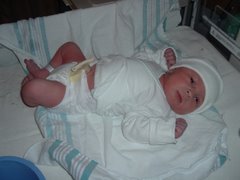
I've been meaning to post about breastfeeding for a while. I actually have several posts to do on this. The mothers out there know what a rocky road it is. Today's topic is extended breastfeeding, something that's usually reserved for snide whispers. In this country its considered a bit weird, and I admit to having a mental stereotype of people who do it, something I had a little internal struggle with when we hit the 12 month mark.
The AMA recommends breastfeeding exclusive for the 1st 6 months, and continuing for "atleast" the first year. The WHO recommends 2 years. Why the discrepancy? Well, I think this country is struggling to overcome its midcentury belief that "only poor people breastfeed", "its gross", and "formula is best". After that PR nightmare (did the formula companies use the same ad agency as cigarettes? seriously!) 12 months may be a stretch goal. The WHO on the otherhand is trying to make sure that children in the undeveloped world get one of the few advantages mother's can afford. It's also the best tool they have to stave off waterborn illnness, a major cause of infant death, since there's no need to mix it with water.
Most American mothers try to breastfeed in the hospital, more than half don't make it 2 months. The ones who make it through say "whew" at the 12 month mark and swiftly switch to cow's milk. There is a small minority that keeps going. As a new mother, I had a goal of 6 months, and then see what happens. (After the first few days and weeks, that seemed like an impossible achievement--but that's another post). I read up a bit on the recommendations, and started prying open my own mind on the idea of extended nursing. Apparently, there's scant scientific evidence of the benefits of toddler nursing in the US, but numerous studies have tried to find the negatives (science to support public opinion?) and they didn't come up with any.
About a year ago, I saw my doctor for my 6 month post partum check-up. We were talking about breastfeeding, and she casually said how things would go...and then we'd be toddler nursing, night and morning... What-What!? I heard the electronic rewind screech in my mind when she said it.
At 12 months, we were still breastfeeding. Jackson loved it. The descriptives, "alactrity", "enthusiasm", and "gusto" are inadequate to convey his excitement for nursing, or the sense of urgency he puts into it. I'm away from my baby 9 hours a day, so I wasn't about to deny him something that is clearly so important to him.
I did decide to break him from the all night feeding. This was really hard! I tried to use a gradual method to stop it. I set up some rules. 1--Jackson had to sleep in his own bed (right next to mine) until 5am. 2--No picking up screaming child (and he screamed!!) 3--I would give him milk when he asked for it, but only from a bottle. 4--After a few weeks, I would start diluting the milk with water until it was just water. Amazingly, the strategy worked. The first few nights were brutal, but after a week, Jackson agreed to go back to sleep in his own bed, and within 6 weeks, he was sleeping without sustenance from 7:30-5:00 (sometimes 4:30) when he woke for milk, and went back to sleep for an hour. (Such a relief after over a year of hourly interrupted sleep).
This method meant that I still had to pack my pump to and from work, and keep my timeslot in the overpacked lactation room so that I would have milk for overnight. There was another woman with a child the same age as Jack. On his 1st birthday, she [smugly] posted a note regarding her freedom from the milk machine. I was feeling like the weird woman who was still breastfeeding--How old is that child!? Then I checked in on my friend in my old lactation room, and she was still feeding her son. I asked a few more people and found out that there are actually a bunch of us quietly continuing past the first year. Many of us are professionals, surprisingly continuing to put in the extra effort.
Jackson was already weaned during the day since he was driven to vampirism early. (see Milk, soap, and cheese.) That's not the case for everyone. I saw my friend this summer who has extended breastfed all of her children. I was impressed at her patience--she spent 1/2 hour exposed in the kitchen while her 14 month old suckled and napped intermittently.
We're now at 18 months, and continuing to nurse for some indeterminate length of time. Jack's enthusiasm has not waned. We've had a cold this weekend, and Jackson hasn't been able to breath and suck at the same time. The other night, he threw an absolute fit when he couldn't suckle. He was writhing around and bawling. Luckily Jason was home, and able to sit with him while I dug my pump out of the closet. I put the milk in a sippy cup, and Jackson bawled louder, refusing to take it. He was relieved when I put in into a bottle. I wasn't able to pump much milk, and the wailing resumed when it was gone. Fortunatley, I still have stock in the freezer.
There are studies that show that antibody levels in toddler breast milk are even higher than in milk produced for young babies. I noticed my milk looks thicker than it used to, and I'm glad I can offer it.
I don't see myself as someone who fits the typical stereotype of a la leche leaguer. I think I'm as close as an engaged parent gets to the opposite of that. I'm not someone who gushes about the bonding that comes from nursing. I don't experience that personally, although I think Jackson does. I nurse because I know it offers advantages in immunity, allergy prevention, IQ, and development. I'm skeptical about the food industry (apparently with good reason--so glad I'm not in China!), and I don't believe they can adequately synthesize a food that has evolved over millenia. I want to make sure my child has the advantages that are within my means to provide.
I hope reading my story widened your awareness a bit. I'm not going to tell anyone how to raise their children, but I want other mother's to know that its OK either way, and I'd like to dissipate some of the whispers uttered at the expense of those of us who take "atleast 12 months" to mean something besides "exactly 12 months".
Showing posts with label milk. Show all posts
Showing posts with label milk. Show all posts
Wednesday, November 5, 2008


Friday, October 19, 2007
Milk, soap, and cheese.
So, maybe you've heard me complain that Jackson barely eats during the day while I'm at work. Instead, he saves up to cluster feed in the evenings, and then all night long. Before I went back to work, he would cluster feed in the morning, and I had him down to one middle on the night waking and one early morning waking--when I should really get up anyway. Within a month, he'd completely changed his pattern and was getting up 5 times every night. I couldn't figure it out. He was getting the same milk, maybe he just didn't like the bottle?
Two weeks ago, I was driving to work, and it just hit me why he might be reluctant to eat while I'm gone. I remembered a few times the bottled milk had developed a strong odor. I just dismissed it as "normal" because I always follow the recommended food safety guidelines for milk storage. I have the Dr Sears Breastfeeding book, and I remember reading a single paragraph about the enzyme lipase, which breaks down the fat. It says that rarely, the lipase concentration is high, and the milk develops a "soapy" taste within about 24 hours. I interpret the word "rare" as "couldn't possibly happen to me, and probably not even anyone I know". I was surprised a few months ago when my friend said that she had that problem, and it took her a while to figure out, so she ended up wasting a lot of frozen milk.
So, I'd read about it, and heard about someone I knew with the condition, but it took me another 6 weeks to think that just maybe, I had the same problem. I went home and compared the days fresh milk with some milk that was a few days old, and quite possibly mixed with some frozen milk. The fresh milk tasted like cows milk with a ton of brown sugar stirred in. The older milk tasted terrible with an after taste that burned my throat. It was horribly. No wonder Jackson doesn't eat very much while I'm gone.
So I called my friend to see what she's doing to treat the milk. Unfortunately, I got her machine. Lucky for me, I have a whole world of information at my fingertips. Here's what I found out:
My first search was for "soap breast milk". I pulled up a whole string of websites with instructions on how to make homemade soap from your excess breast milk. Yes people, that's really what came up. Step by step directions and discussions of the antibiotic properties of breast milk thus the amazing wound cleaning power of the breast milk soap. Well, I'm glad to know there are all kinds of people in the world. I'm pretty open minded, but I don't think this one's for me.
I don't remember how I worded the next search, but the first thing to come up was a woman's account of her attempt to make--wait for it--breast milk cheese. You did read that correctly, cheese. Apparently, she's been using the breast milk around the kitchen, in omelets and brownies. She's also had some experience making fresh soft cow's milk cheese. What better use for the excess frozen human milk. So, she boiled the milk and added some vinegar to curdle it. Nothing happened, so she added more vinegar, and even more vinegar. At the end of the day, she'd added a ton of vinegar, and still didn't have cheese. As it turns out, human milk chemistry prevents curdling. The woman was heartbroken at having to waste all of that milk (I do sympathize), but I was relieved that no one had to eat that cheese.
I guess the third time really is the charm, because my next search netted the information I needed and no more shocking revelations about what the crazies are up to. The milk needs to be scalded at 180F or held at 160F for a few minutes. It's recommended to do this on the stove top in order to preserve the most nutrients. Many people use the microwave until the milk is "steamy" for the sake of convenience.
I went for the stove top, carefully pouring the milk into the pan and trying to pour it back. I lost quite a bit in the process. Since then, I've found I can simply put the glass bottles of milk in the pot of hot water (loosen the lids for safety), scald it, and put the bottles in the fridge to cool. No more spilled milk, not too inconvenient.
I still have 130 ounces of frozen disgusting milk (three days worth). I don't have the will to toss it. While I still respect Dr Sears on other topics, I blame him for the bad milk and for the sleepless nights. What they should have said is that ALL breastmilk contains lipase and sometimes the concentration is high enough to cause spoiling. If you notice strong odors, and your baby is reluctant to eat, your milk is probably affected. Then they should explain what to do about it. For being advocates of breast feeding, this bit of misinformation has probably led many women to give up.
Here's the website: http://www.indrani.net/index.php?q=2006/03/breast_milk_cheese
Two weeks ago, I was driving to work, and it just hit me why he might be reluctant to eat while I'm gone. I remembered a few times the bottled milk had developed a strong odor. I just dismissed it as "normal" because I always follow the recommended food safety guidelines for milk storage. I have the Dr Sears Breastfeeding book, and I remember reading a single paragraph about the enzyme lipase, which breaks down the fat. It says that rarely, the lipase concentration is high, and the milk develops a "soapy" taste within about 24 hours. I interpret the word "rare" as "couldn't possibly happen to me, and probably not even anyone I know". I was surprised a few months ago when my friend said that she had that problem, and it took her a while to figure out, so she ended up wasting a lot of frozen milk.
So, I'd read about it, and heard about someone I knew with the condition, but it took me another 6 weeks to think that just maybe, I had the same problem. I went home and compared the days fresh milk with some milk that was a few days old, and quite possibly mixed with some frozen milk. The fresh milk tasted like cows milk with a ton of brown sugar stirred in. The older milk tasted terrible with an after taste that burned my throat. It was horribly. No wonder Jackson doesn't eat very much while I'm gone.
So I called my friend to see what she's doing to treat the milk. Unfortunately, I got her machine. Lucky for me, I have a whole world of information at my fingertips. Here's what I found out:
My first search was for "soap breast milk". I pulled up a whole string of websites with instructions on how to make homemade soap from your excess breast milk. Yes people, that's really what came up. Step by step directions and discussions of the antibiotic properties of breast milk thus the amazing wound cleaning power of the breast milk soap. Well, I'm glad to know there are all kinds of people in the world. I'm pretty open minded, but I don't think this one's for me.
I don't remember how I worded the next search, but the first thing to come up was a woman's account of her attempt to make--wait for it--breast milk cheese. You did read that correctly, cheese. Apparently, she's been using the breast milk around the kitchen, in omelets and brownies. She's also had some experience making fresh soft cow's milk cheese. What better use for the excess frozen human milk. So, she boiled the milk and added some vinegar to curdle it. Nothing happened, so she added more vinegar, and even more vinegar. At the end of the day, she'd added a ton of vinegar, and still didn't have cheese. As it turns out, human milk chemistry prevents curdling. The woman was heartbroken at having to waste all of that milk (I do sympathize), but I was relieved that no one had to eat that cheese.
I guess the third time really is the charm, because my next search netted the information I needed and no more shocking revelations about what the crazies are up to. The milk needs to be scalded at 180F or held at 160F for a few minutes. It's recommended to do this on the stove top in order to preserve the most nutrients. Many people use the microwave until the milk is "steamy" for the sake of convenience.
I went for the stove top, carefully pouring the milk into the pan and trying to pour it back. I lost quite a bit in the process. Since then, I've found I can simply put the glass bottles of milk in the pot of hot water (loosen the lids for safety), scald it, and put the bottles in the fridge to cool. No more spilled milk, not too inconvenient.
I still have 130 ounces of frozen disgusting milk (three days worth). I don't have the will to toss it. While I still respect Dr Sears on other topics, I blame him for the bad milk and for the sleepless nights. What they should have said is that ALL breastmilk contains lipase and sometimes the concentration is high enough to cause spoiling. If you notice strong odors, and your baby is reluctant to eat, your milk is probably affected. Then they should explain what to do about it. For being advocates of breast feeding, this bit of misinformation has probably led many women to give up.
Here's the website: http://www.indrani.net/index.php?q=2006/03/breast_milk_cheese
Subscribe to:
Posts (Atom)